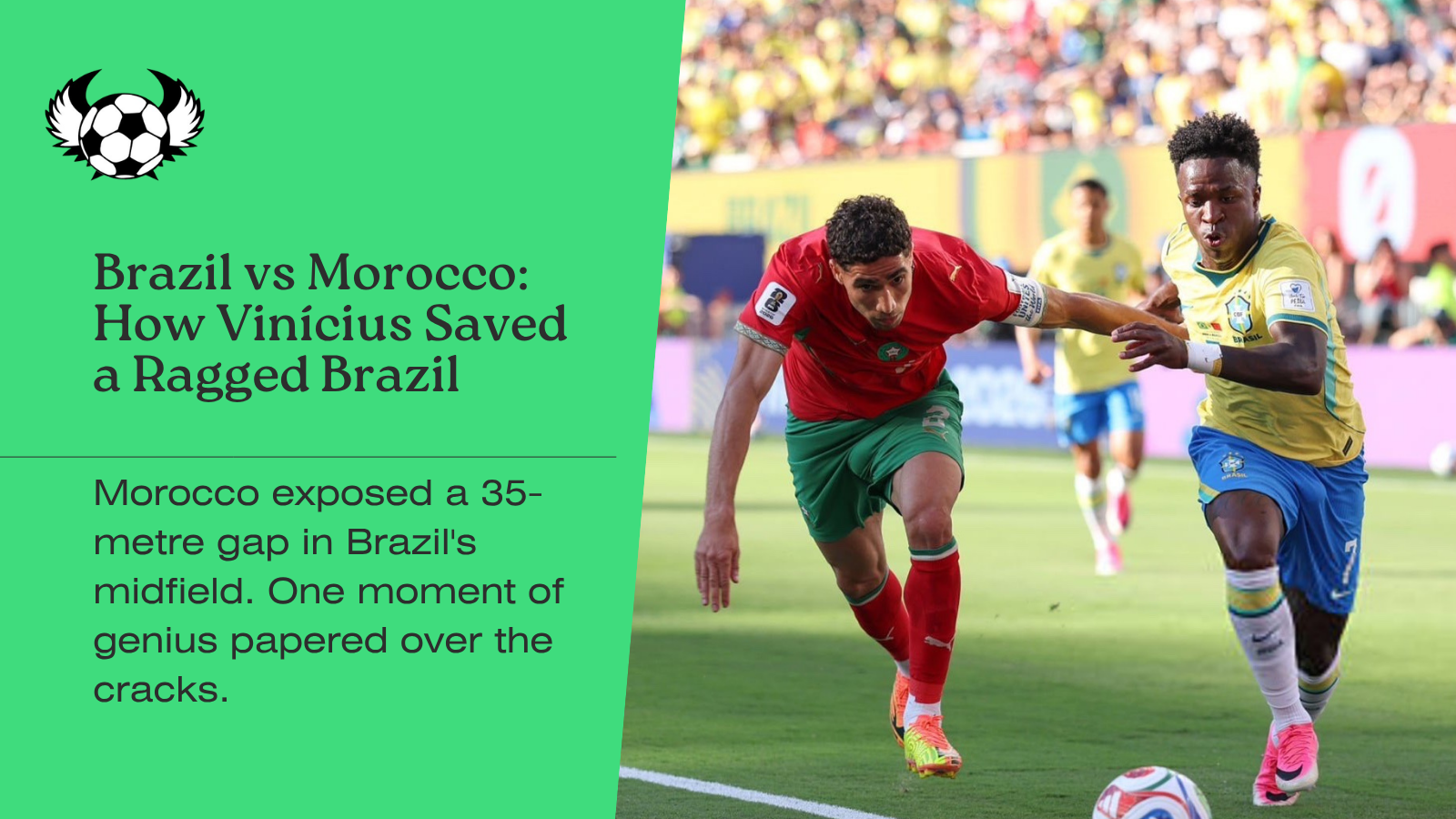
In the Brazil vs Morocco 2026 World Cup group stage clash, Brazil escaped with a point at MetLife Stadium, but the 1-1 scoreline concealed a deeper structural concern. Carlo Ancelotti’s side were not undone by superior pressing, wing overloads, or individual errors. The defining tactical fault was the lack of vertical compactness between Brazil’s midfield unit and defensive line. Morocco repeatedly accessed this ungoverned zone during first-half transitions, creating the conditions that produced Ismael Saibari’s opener and several other dangerous sequences.
The match offered an early World Cup case study in how a team can maintain territorial parity and possession control while losing command of the pitch’s most valuable spaces. Brazil finished with 51% possession and 514 passes compared to Morocco’s 486, yet Mohamed Ouahbi’s side generated the higher expected-goals total (1.37 xG versus 1.26 xG) and produced more shots (14 to 12). The underlying numbers align closely with what was visible tactically: Morocco consistently found cleaner routes into high-value attacking zones.
The Tactical Thesis: Brazil’s Missing Middle
On paper, Brazil’s midfield should have provided control. Casemiro operated as the deepest midfielder, with Bruno Guimarães and Lucas Paquetá positioned ahead of him. In practice, however, the trio functioned as separate units rather than a synchronized block.
Embed from Getty ImagesWhenever Brazil advanced possession, Guimarães and Paquetá frequently occupied aggressive positions between Morocco’s midfield and defensive lines. Casemiro remained deeper to protect transitions. The result was a significant disconnect in the central corridor. Instead of maintaining a compact structure, Brazil often left approximately 35 to 40 metres between their midfield screen and retreating centre-backs.
This gap became Morocco’s primary attacking platform.
Rather than forcing wide progression, Brazil repeatedly allowed Morocco’s attacking midfielders to receive between the lines facing goal. Once possession entered this zone, Morocco’s technical players immediately accelerated attacks through vertical combinations.
The issue was not numerical inferiority. It was spacing. Brazil frequently had enough players behind the ball, but not enough players occupying the critical spaces between the ball and their defensive line.
Morocco recognized the weakness early and built their attacking strategy around it.
The Numbers Behind Morocco’s Control
The statistical profile strongly supports the tactical picture.
Despite nearly identical possession shares, Morocco recorded:
- More shots (14 vs 12)
- More big chances (2 vs 1)
- Higher expected goals (1.37 vs 1.26)
- Significantly more successful dribbles (16 vs 5)
- More duels won (62 vs 53)
The dribble differential is particularly revealing. Morocco’s attackers consistently received possession with momentum and space ahead of them. Teams forced into sterile possession rarely complete 16 successful dribbles against Brazil.
Much of that success originated from transitional moments.
When Morocco recovered possession, they bypassed Brazil’s first line quickly. Brahim Díaz became the primary connector. Rather than dropping deep to build attacks, he positioned himself directly inside the space between Casemiro and the defensive line. From there, he could receive on the half-turn and immediately attack depth.
The opening goal in the 21st minute emerged from precisely this pattern.
Embed from Getty ImagesBrazil’s midfield failed to collapse around the receiver quickly enough. Díaz received in the seam, drew defenders toward him, and released a penetrative pass into the channel. Saibari attacked the space aggressively and finished the move. The goal was less about individual brilliance than repeated structural access to the same vulnerable zone.
Saibari’s individual metrics underline his influence. He accumulated 0.71 xG from relatively limited involvement, registering only 33 touches. That is an indicator of efficient chance generation rather than volume possession. Morocco repeatedly delivered him into dangerous areas rather than asking him to create danger from deep.
Meanwhile, Morocco midfielder Neil El Aynaoui quietly controlled large portions of the contest. His 47 accurate passes, 70 touches, seven defensive contributions, and nine duel wins reflected a player operating comfortably within a well-organized structure.
Brazil’s Possession Without Control
One of the more interesting contradictions of the match was Brazil’s ability to circulate possession effectively while struggling to control game flow.
The Seleção completed 449 accurate passes and accumulated 704 total touches. Bruno Guimarães alone recorded 97 touches and 34 accurate passes. Yet possession frequently lacked positional security.
This distinction is important.
Possession dominance and spatial control are not interchangeable concepts. Brazil moved the ball efficiently enough but failed to establish effective rest defense behind attacks. When possession was lost, Morocco immediately found access to central areas because the distances between Brazil’s units were too large.
A well-constructed rest defense limits transitional access to the central corridor. Brazil’s version often consisted of isolated defenders protecting large spaces rather than compact units protecting zones.
The consequence was repeated transition exposure.
Morocco’s ability to complete 16 successful dribbles was partially a reflection of this. Attackers were not confronting compact defensive blocks. They were receiving opportunities to drive directly at retreating defenders.
Vinícius Júnior and the Individual Solution
Brazil’s equalizer in the 32nd minute arrived through a player capable of solving problems that structures cannot.
Vinícius Júnior’s performance represented the difference between Brazil leaving with a draw and potentially suffering defeat.
Embed from Getty ImagesHis overall statistical output appears modest at first glance. An xG of just 0.08 would not normally indicate a decisive attacking display. However, his xGOT figure of 0.54 highlights the exceptional quality of the strike itself.
The goal altered the game’s emotional and tactical balance.
While Brazil struggled collectively, Vinícius remained capable of creating destabilization through individual actions. Morocco’s defensive structure was largely sound throughout the first half, but elite attackers require only one opening.
His match-winning qualities extended beyond the goal. Morocco consistently adjusted defensive attention toward his flank, creating secondary spaces elsewhere. Even when not directly involved, Vinícius altered Morocco’s defensive orientation.
The broader lesson is less flattering for Brazil. Their equalizer emerged primarily through individual quality rather than a structural correction.
Ancelotti’s Halftime Response
Ancelotti’s first significant intervention arrived immediately after halftime.
Embed from Getty ImagesCasemiro was replaced by Fabinho, while Roger Ibañez made way for Danilo. The changes indicated a desire to improve defensive connectivity and positional balance.
The adjustment delivered mixed results.
Brazil looked marginally more compact after the interval. Fabinho operated with slightly different positioning, reducing some of the vertical separation that had existed during the opening 45 minutes. Morocco also began losing some of the physical intensity that had fueled their transition attacks.
Ancelotti later suggested that Morocco’s declining energy levels contributed significantly to the improved balance.
The data supports that interpretation.
Morocco continued generating opportunities but with less frequency. The open central receptions that characterized the first half became less common. Brazil were no longer being stretched as aggressively between lines.
However, the underlying structural concern never completely disappeared.
Subsequent substitutions introducing Matheus Cunha and Luiz Henrique increased attacking threat but did not fundamentally alter the midfield geometry. Brazil improved the symptoms more than the root cause.
The Key Individual Matchups
Brahim Díaz vs Brazil’s Midfield Screen
Embed from Getty ImagesThis was arguably the most influential tactical battle of the match.
Brazil never established effective central corridor denial against Díaz. He consistently occupied the space behind Brazil’s midfield and ahead of the centre-backs. Every successful reception forced difficult decisions from Gabriel and Marquinhos.
Step forward and expose depth.
Stay deep and allow progression.
Morocco repeatedly benefited from that dilemma.
Achraf Hakimi vs Vinícius Júnior
Embed from Getty ImagesHakimi produced a disciplined defensive display despite facing Brazil’s most dangerous attacker.
The Moroccan captain finished with 83 touches, 44 accurate passes, seven defensive contributions, and 11 duel wins. His willingness to balance attacking ambition with defensive responsibility prevented Vinícius from receiving repeated isolation opportunities.
Yet even elite defensive performances can be undone by elite finishing quality, which ultimately happened when Vinícius converted Brazil’s equalizer.
Ismael Saibari vs Brazil’s Defensive Line
Embed from Getty ImagesSaibari’s movement was central to Morocco’s attacking plan.
Rather than remaining fixed between centre-backs, he constantly attacked the channels created by Brazil’s midfield disconnect. His timing repeatedly synchronized with Díaz’s receptions.
The result was a highly efficient attacking performance reflected by his 0.71 xG total and opening goal.
Why the Draw Should Concern Brazil More Than Morocco
The headline narrative will focus on Vinícius Júnior rescuing Brazil. The tactical story is more complicated.
Brazil did not suffer because of poor effort or a lack of talent. They suffered because their midfield and defensive units operated at incompatible distances during critical moments.
Against Morocco, that flaw produced a draw.
Against stronger opponents later in the tournament, the consequences could be considerably harsher.
Morocco, meanwhile, demonstrated a clear structural identity. Their compact mid-block, disciplined transition framework, and aggressive exploitation of half-spaces consistently created problems for one of the tournament favorites.
The match ended level on the scoreboard, but the tactical evidence suggested Morocco’s collective organization frequently outperformed Brazil’s positional structure.