The Tactical Thesis: Germany Didn’t Win Through Volume. They Won Through Positioning.
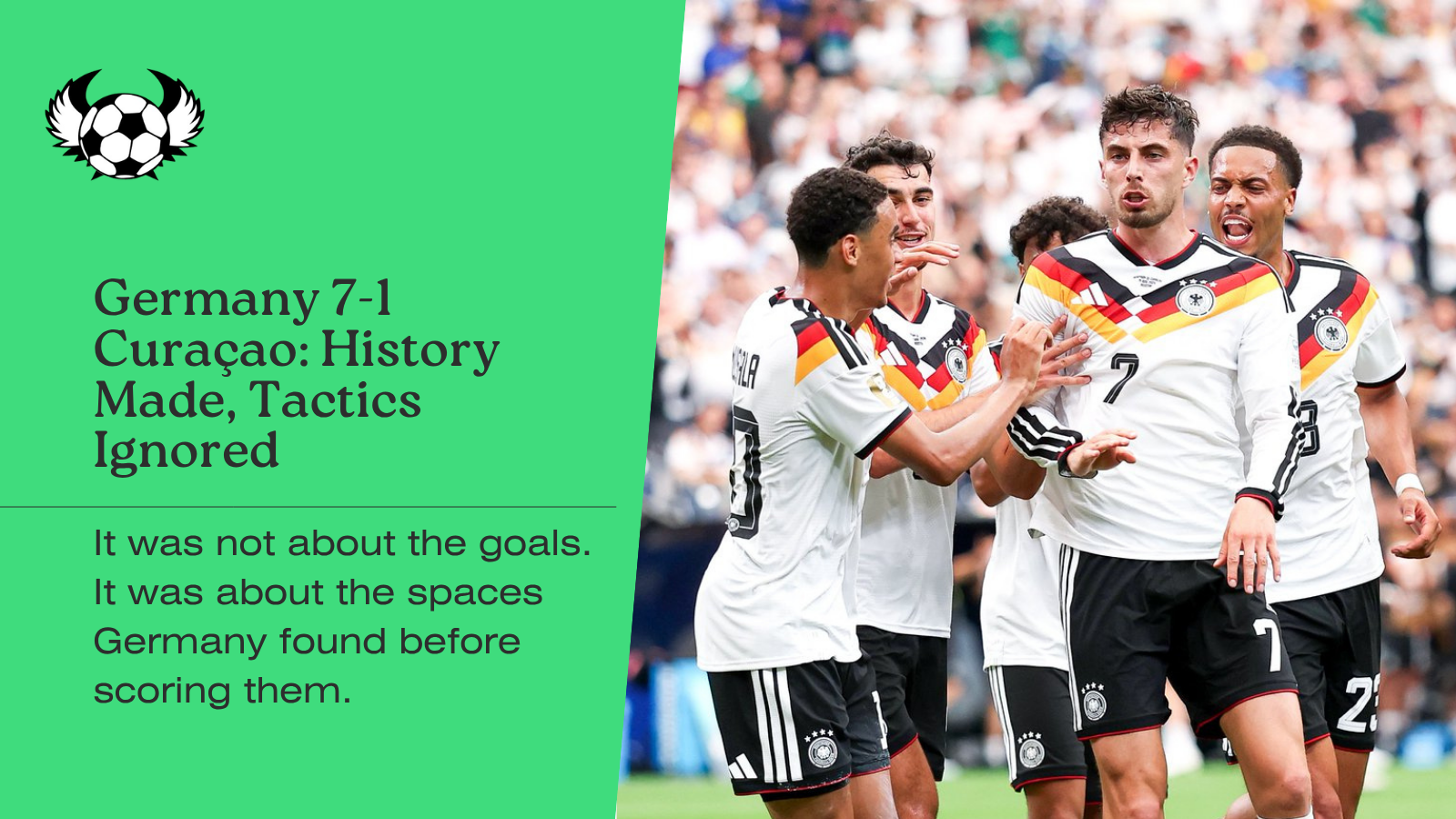
The Germany vs Curaçao 2026 World Cup group stage clash ended 7-1, but the scoreline will inevitably dominate the discussion. Germany became the first nation in World Cup history to record three separate 7+ goal victories at the tournament, adding Curaçao to previous demolitions of Saudi Arabia in 2002 and Brazil in 2014. Yet the match itself was not primarily a story about finishing, individual brilliance, or overwhelming pressure.
It was a story about positional superiority.
Julian Nagelsmann’s Germany repeatedly accessed areas of the pitch that Curaçao’s defensive structure was incapable of protecting. Dick Advocaat deployed a compact 4-4-2 designed to deny central progression and reduce direct access into Germany’s attacking midfielders. The concept was understandable. The execution created a different problem.
By narrowing their midfield line to protect the central corridor, Curaçao repeatedly exposed the half-spaces on either side of their central block. Germany immediately identified the weakness and spent the entire match attacking those channels through third-man combinations involving Joshua Kimmich, Florian Wirtz, Jamal Musiala and Leroy Sané.
The final score reflected Germany’s ruthless finishing. The tactical foundation was established much earlier through structural manipulation of Curaçao’s shape.
Germany’s Positional Overloads Created Constant Numerical Advantages
The possession figures alone tell only part of the story.
Germany controlled 65% possession, completed 554 accurate passes from 637 attempts and accumulated 812 touches. Those numbers suggest territorial dominance, but the more revealing statistics are found further up the pitch.
Germany generated 26 shots from 4.22 expected goals while creating six big chances. Curaçao, despite remaining compact for long stretches, failed to produce a single big chance and finished with just 0.41 xG.
The disparity emerged because Germany consistently created numerical superiority in advanced zones.
Nagelsmann’s attacking structure frequently resembled a rotating 3-2-5 in possession. Kimmich operated as the primary distributor, while Wirtz occupied spaces between Curaçao’s midfield and defensive lines. Musiala and Sané alternated between wide positions and interior half-space occupations, forcing Curaçao’s midfield four into impossible decisions.
If the midfield remained narrow, Germany gained free access to the half-spaces.
If a midfielder shifted outward to close those channels, Wirtz received centrally.
Either outcome favoured Germany.
The pattern became increasingly visible after the opening goal. Felix Nmecha’s sixth-minute strike settled Germany early, but Curaçao briefly responded through Livano Comenencia’s equaliser in the 21st minute. Rather than disrupting Germany’s structure, the goal merely exposed a separate issue regarding Germany’s transitional defending.
In possession, Germany remained completely in control.
Wirtz as the Structural Reference Point
The match revolved around Florian Wirtz.
Although he finished without a goal, his influence was visible in almost every significant attacking sequence. His numbers were substantial without being spectacular: 84 touches, 55 accurate passes and 0.46 expected assists.
The importance of those figures lies in where the touches occurred.
Wirtz repeatedly positioned himself in the seam between Curaçao’s midfield and defensive lines. Every time a Curaçao midfielder stepped forward to engage him, Germany gained access behind the pressing player. Every time the midfield held its shape, Wirtz received freely between the lines.
This is where Germany’s third-man combinations became devastating.
Kimmich frequently initiated attacks with progressive passes into Wirtz. Rather than turning immediately, Wirtz often acted as the second player in a passing sequence, laying the ball off first time into the path of an arriving runner.
The runner became the third man.
Because Curaçao’s midfield had already been manipulated by the initial movement, recovery runs were often impossible.
The 47th-minute goal from Musiala was the clearest example. Kimmich penetrated the first defensive layer, Wirtz connected the sequence, and Musiala attacked the vacated channel. The movement appeared simple. The defensive consequences were severe because Curaçao’s structure had already been displaced before the final pass arrived.
Why Curaçao’s Compact Block Became a Liability
Compact defensive blocks are designed to deny central progression.
Curaçao succeeded in that objective only partially.
Their midfield four consistently compressed the central corridor, but doing so created structural voids elsewhere. Germany’s front five stretched the width of the pitch, forcing defenders into constant horizontal movement.
The result was a defensive shape that looked compact but functioned with significant spacing issues.
Nathaniel Brown became one of the major beneficiaries.
Whenever Sané held width on the left side, Curaçao’s right-back was dragged outward. The movement opened an interior lane for Brown’s overlapping runs. Because Curaçao’s midfield was already committed to protecting central zones, there was often no player available to track the run without disrupting the rest of the block.
Brown’s 68th-minute goal was the logical conclusion of that pattern rather than an isolated moment.
His performance reflected his broader tactical importance. The full-back produced an xA figure of 0.57 alongside his goal and repeatedly arrived in advanced positions undetected.
Germany were not merely creating chances.
They were repeatedly delivering players into zones where defensive responsibility had become unclear.
Kimmich’s Distribution Dictated the Tempo
Few players better illustrated Germany’s superiority than Joshua Kimmich.
The captain recorded 87 touches, 65 accurate passes and an outstanding 0.83 expected assists. More importantly, he controlled the rhythm of Germany’s attacks.
Curaçao attempted to maintain a compact mid-block for much of the match, but Kimmich consistently found passing angles capable of bypassing multiple defenders.
His role extended beyond simple ball circulation.
The quality of his progressive passing metrics repeatedly accelerated Germany through the first two defensive lines. Rather than forcing vertical attacks immediately, Kimmich often delayed the decisive pass until Curaçao’s midfield had shifted slightly off balance.
That patience was critical.
Germany’s most dangerous attacks emerged not from speed alone but from precise timing.
By the time the ball reached Musiala, Wirtz or Sané, Curaçao’s structure was already reacting rather than controlling.
Musiala, Havertz and the Occupation of Space
Germany’s attacking line demonstrated a sophisticated understanding of positional play.
Musiala’s contribution extended well beyond his goal. He completed four successful dribbles, won nine duels and constantly manipulated defenders through intelligent movement between the lines.
Kai Havertz ultimately finished with two goals and an xG figure of 1.01. His performance earned Man of the Match recognition, but his movement was arguably more important than his finishing.
Rather than operating as a traditional striker, Havertz frequently vacated central spaces, drawing centre-backs away from their preferred positions.
Those movements created secondary channels for runners arriving from deeper zones.
Musiala exploited them.
Brown exploited them.
Undav exploited them after entering from the bench.
By the final stages of the match, Curaçao’s defensive line was reacting to multiple threats simultaneously, a situation that heavily favoured Germany’s fluid attack.
The One Concern Nagelsmann Cannot Ignore
The scoreline risks masking Germany’s most obvious weakness.
Curaçao scored from one of the few moments in which Germany’s rest defense lost structural discipline during transition. Even against an opponent that generated only 0.41 xG, Germany occasionally looked vulnerable when possession changed hands unexpectedly.
Against stronger opposition, those moments will receive far greater punishment.
Germany conceded only eight shots and allowed no big chances, so the defensive concern should not be exaggerated. However, the contrast between their attacking precision and occasional transitional looseness remains noticeable.
The same aggressive positioning that fuels Germany’s attack can expose space behind the ball if the first defensive action after possession loss is unsuccessful.
For now, Germany can afford that trade-off.
Group-stage opponents have struggled to live with their attacking structure.
Later rounds may present a different challenge.
History Was Made. The Tactical Story Matters More.
The headlines will focus on seven goals, records and another emphatic German World Cup victory.
The more significant development was the sophistication of Germany’s attacking framework.
Nagelsmann’s side did not overwhelm Curaçao through relentless pressure or sheer attacking volume. They systematically manipulated defensive spacing, exploited half-space channels and created third-man combinations that Curaçao’s structure could neither track nor recover against.
The numbers support the eye test: 4.22 expected goals, six big chances, 26 shots and complete territorial control.
Yet beneath the statistics sat a far more important reality.
Germany’s positional attack is functioning at an elite level. Wirtz’s occupation of intermediate spaces, Kimmich’s distribution, Musiala’s channel running and Brown’s overlapping timing formed a coherent attacking ecosystem rather than a collection of individual performances.
Curaçao were eventually overwhelmed by the scoreline.
They had been overwhelmed by the structure long before that.