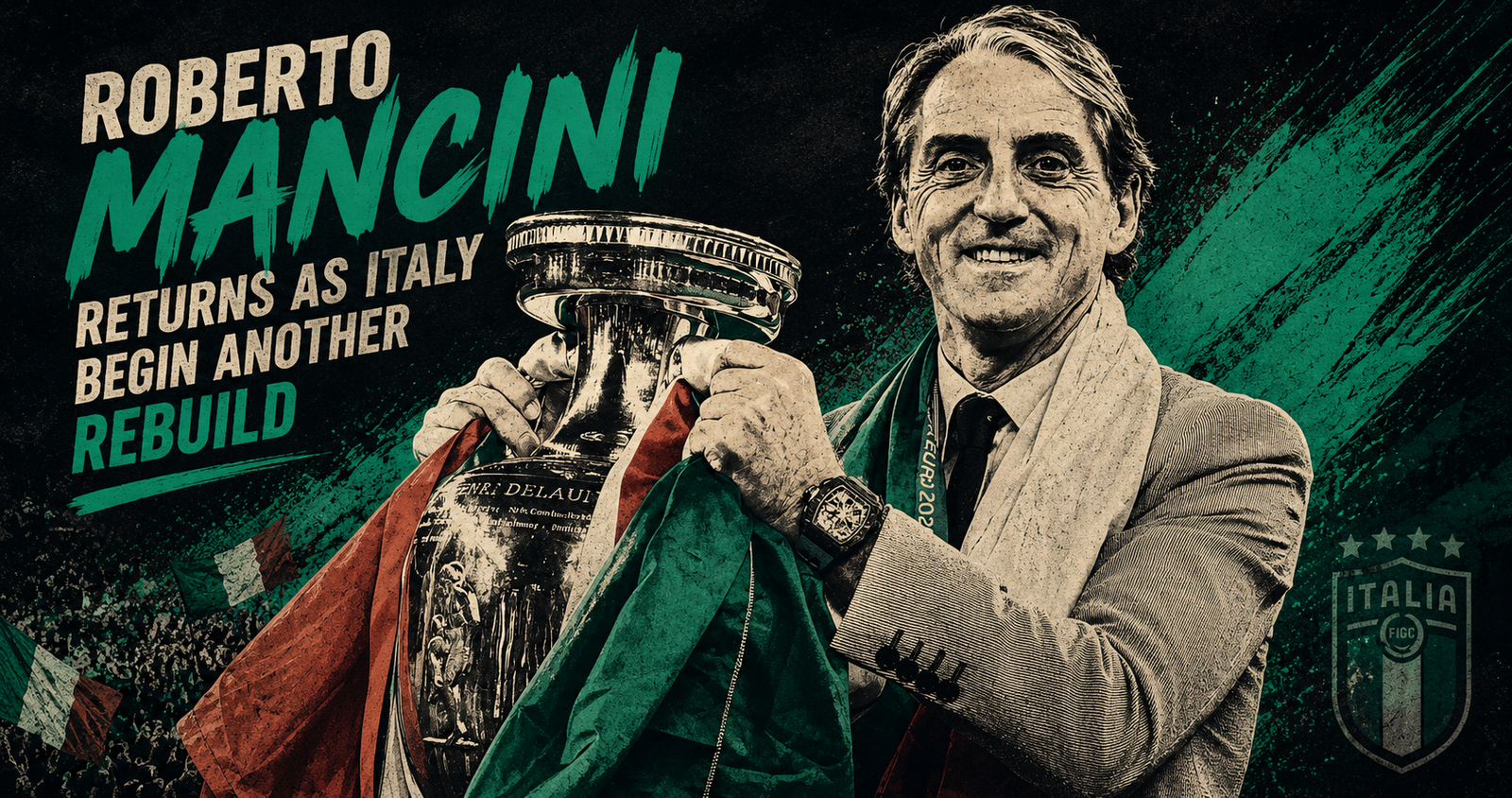
Roberto Mancini returns as Italy head coach, while Claudio Ranieri has been appointed FIGC Technical Director and President of Club Italia in a sweeping leadership reshuffle announced by Italian Football Federation president Giovanni Malagò.
The appointments, confirmed after the Federal Council meeting, reunite one of Italy’s most successful modern national-team coaches with one of the country’s most respected football figures. Mancini will lead the senior men’s national team, while Ranieri takes responsibility for the federation’s wider technical direction and Club Italia.
“I believed it was right that the person to become Head Coach of the national team should be Roberto Mancini, for a variety of reasons,” Malagò said.
Explaining Ranieri’s appointment, he added: “To complete the jigsaw, I felt it was right to find someone with whom to share the choice of Head Coach. That person is Claudio Ranieri, who has assured me of his commitment.”
The federation also confirmed that a third figure will soon be appointed as national teams manager, replacing the position previously held by Luigi Riva and Gianluigi Buffon, while youth coordinator Maurizio Viscidi will remain within the organisation.
Mancini and Ranieri officially assume their new roles immediately, with their first joint media appearance scheduled at FIGC headquarters on 29 July.
The return of the coach who guided Italy to Euro 2020 glory is the headline. The more significant question is why the federation has paired him with Ranieri in a new leadership structure rather than simply appointing another head coach. After years of disappointing results and repeated upheaval, the FIGC is attempting a different approach to leading the national team.
Why Italy needed another reset under Roberto Mancini
Italy’s latest leadership overhaul was not driven by a single defeat. It followed years of sporting disappointment and administrative instability that culminated in another historic setback.
The defining blow came during the 2026 FIFA World Cup qualifying campaign. After finishing behind Norway in their qualifying group, Italy defeated Northern Ireland in the play-off semi-final before losing on penalties to Bosnia and Herzegovina in Zenica.
The defeat made Italy the first former world champions to fail to qualify for three consecutive FIFA World Cups, extending absences that had already seen the Azzurri miss Russia 2018 and Qatar 2022.
The consequences were immediate.
Luciano Spalletti had already departed following Italy’s disappointing Euro 2024 campaign and poor start to World Cup qualifying. His successor, Gennaro Gattuso, was appointed in June 2025 in an attempt to rescue qualification but stepped down by mutual consent after the defeat to Bosnia and Herzegovina, describing the decision as one made “with pain in my heart”.
The changes extended beyond the dugout.
FIGC president Gabriele Gravina and head of delegation Gianluigi Buffon both resigned following the failed qualification campaign, leaving Giovanni Malagò to oversee a period of transition while the federation searched for a new direction.
That search quickly became more complicated.
Earlier in July 2026, Paolo Maldini had been appointed technical director and Leonardo brought in as a special adviser as part of a new leadership structure. However, disagreements surrounding Andrea Pirlo’s proposed appointment as head coach led both men to resign after just 16 days, forcing the federation back to the drawing board.
Instead of beginning another lengthy recruitment process, the FIGC turned to two experienced figures with very different responsibilities. Mancini has been asked to restore the senior team, while Ranieri has been brought in to oversee the broader football structure that supports it.
Why Roberto Mancini is back
Few appointments in recent Italian football have generated as much debate as Roberto Mancini’s return.
His first spell as Italy head coach produced some of the national team’s finest modern achievements. Appointed in May 2018 after Italy failed to qualify for the World Cup, he rebuilt both the squad and its playing identity.
The high point came in July 2021 when Italy defeated England on penalties at Wembley to win the UEFA European Championship. Alongside that triumph, Mancini guided the Azzurri through a world-record run of 37 consecutive unbeaten international matches and consecutive third-place finishes in the UEFA Nations League Finals.
His Italy side also represented a stylistic shift. Rather than relying on the cautious, reactive football traditionally associated with the national team, Mancini introduced a more proactive approach based on possession, pressing and technical quality.
His first tenure, however, was not without significant setbacks.
Despite winning Euro 2020, Italy failed to qualify for the 2022 FIFA World Cup after a shock home play-off defeat to North Macedonia. Questions also emerged over the team’s lack of goals, while the search for a reliable centre-forward remained unresolved.
As performances declined after the European Championship, Mancini was criticised for relying too heavily on members of the title-winning squad instead of accelerating the integration of younger players.
His departure in August 2023 added another layer of controversy. Mancini resigned less than a year before Euro 2024 despite having recently extended his contract, with reported friction surrounding structural changes inside the federation contributing to his decision. He then accepted a lucrative offer to coach Saudi Arabia, a move that damaged his standing among many Italian supporters.
Those circumstances help explain why his return has divided opinion.
Questions about the manner of his departure remain valid, but federations are ultimately judged by the decisions they believe give their national teams the best chance of improving. In Italy’s current situation, the FIGC has concluded that Mancini’s previous achievements, familiarity with the international environment and experience of rebuilding the Azzurri outweigh the controversy surrounding his exit.
His immediate task is clear. He must steady a national team shaken by another failed World Cup qualification campaign, prepare for UEFA Nations League fixtures against Belgium and France, and begin building a squad capable of qualifying for Euro 2028 while laying stronger foundations for the 2030 World Cup.
Claudio Ranieri’s new role explained
While Roberto Mancini’s return has attracted most of the attention, Claudio Ranieri’s appointment may prove just as important to Italy’s long-term plans.
Ranieri has been named both FIGC Technical Director and President of Club Italia, placing him at the centre of the federation’s broader football strategy rather than the day-to-day management of the senior national team.
For many supporters, the title requires some explanation. Ranieri will not select Italy’s starting XI or direct matches from the touchline. Instead, he has been appointed to oversee the football structure that supports every national team.
His responsibilities include guiding the federation’s long-term technical direction, overseeing Club Italia and helping strengthen the pathway from the youth teams to the senior squad. Maurizio Viscidi remains responsible for youth development, providing continuity within the existing academy structure while working within the wider framework Ranieri now oversees.
The distinction from Mancini’s role is deliberate. The head coach focuses on preparing the senior side for competition, while the technical director concentrates on the wider systems intended to support that work over time.
Malagò underlined Ranieri’s importance when announcing the appointments.
“I needed someone with whom I could share the decision on the coach,” he said, adding that Ranieri’s agreement “completed the jigsaw”.
His selection reflects more than his coaching record. After months of upheaval, the federation has turned to a figure widely respected for his experience, leadership and ability to bring stability to challenging situations.
How Roberto Mancini and Claudio Ranieri will work together
Italy’s new structure separates immediate football management from longer-term technical planning.
Mancini retains authority over the senior team. Squad selection, tactical preparation, training camps and matchday decisions remain entirely his responsibility, leaving him accountable for performances and results.
Ranieri’s focus is broader. As Technical Director and President of Club Italia, he oversees long-term planning, youth pathways and the federation’s wider football strategy.
That division is designed to complement rather than compete.
One important area of collaboration will be the transition of players from the youth system into the senior squad. Working alongside Viscidi, Ranieri can help ensure emerging talent develops within a consistent football framework before reaching Mancini’s team.
The arrangement also allows each man to concentrate on different priorities. Mancini can devote his attention to preparing the senior side, while Ranieri provides continuity across the wider national-team programme.
This represents a notable shift for the FIGC.
Traditionally, much of Italy’s football direction rested with the national-team coach. Figures such as Enzo Bearzot, Marcello Lippi and Mancini during his first spell carried far broader responsibilities than those now assigned to the head coach.
There have been earlier examples of wider technical oversight, including Arrigo Sacchi’s work with youth development, but the current structure gives those responsibilities greater prominence alongside the senior national team.
Whether the model succeeds will depend less on organisational charts than on how effectively both roles complement each other. The federation has chosen a structure that seeks to balance immediate competitiveness with longer-term planning rather than asking one individual to carry both responsibilities.
How Roberto Mancini could change Italy on the pitch
The most visible changes will come through Roberto Mancini.
His first Italy side challenged traditional perceptions of the Azzurri by favouring possession, aggressive pressing and technical quality over the cautious style often associated with previous generations.
Those principles remain closely linked with Mancini, but the circumstances are different from his first spell.
The squad has changed since Euro 2020, while international football has continued to evolve. That makes a simple return to the past unlikely.
Instead, supporters should expect the broader ideas behind Mancini’s approach to remain while the details adapt to a different group of players.
Several footballing challenges also remain unresolved. Italy continues to search for a reliable centre-forward, while integrating younger players into the senior squad has become increasingly important after successive disappointments.
This is where the federation hopes its revised leadership structure can make a difference. Although Ranieri will not influence matchday tactics, stronger coordination between youth development and the senior team is intended to produce players better prepared for the demands of Mancini’s football.
Rather than treating tactical identity and player development as separate objectives, Italy is attempting to connect them more closely. Whether that leads to improved performances will only become clear over time, but it explains why the federation has paired a head coach with a technical director instead of relying on one appointment alone.
What success would actually look like
Expectations around Italy’s new leadership should be measured over years rather than months.
Mancini’s immediate priority is to restore confidence after another failed World Cup qualification campaign and prepare the national team for its upcoming UEFA Nations League fixtures. Those matches will offer an early indication of progress, but they are unlikely to determine whether the wider project succeeds.
A more meaningful assessment will come over the next international cycle.
Qualification for Euro 2028 is the first major benchmark. After missing the last three World Cups, simply returning to consistent tournament participation would represent tangible progress. Beyond that, building a squad capable of competing at the 2030 World Cup is likely to provide a clearer measure of whether the federation’s decisions have delivered lasting benefits.
Success should also be judged beyond results alone.
From an editorial perspective, the appointments suggest the FIGC wants greater continuity between youth development and the senior national team. If that leads to a clearer pathway for emerging players, stronger succession planning and fewer periods of abrupt transition, the new structure will have achieved more than a short-term improvement in performances.
None of those outcomes have been guaranteed by the federation. They remain objectives that will be tested over time rather than promises that can be measured after a handful of matches.
That perspective matters because rebuilding an international team is fundamentally different from managing a club. Managers have limited time with their players, development takes place across multiple age groups and meaningful progress often emerges over several tournament cycles.
For supporters, patience may prove just as important as results. The real verdict on this project is unlikely to come until Italy has navigated the next European Championship and begun its journey towards the 2030 World Cup.
More than a managerial appointment
Roberto Mancini’s return naturally dominates the headlines. He is the coach who delivered Euro 2020, presided over one of the most successful periods in Italy’s recent history and later departed in controversial circumstances before unexpectedly returning.
Embed from Getty ImagesYet viewing these developments through Mancini alone risks overlooking the federation’s broader decision.
By appointing Claudio Ranieri as Technical Director and President of Club Italia alongside the returning head coach, the FIGC has chosen to separate long-term football leadership from the day-to-day demands of managing the senior team. Whether that model ultimately succeeds remains uncertain, but it marks a clear departure from relying on one individual to carry every responsibility.
That is what makes these appointments significant.
Italy is not simply welcoming back a familiar coach. It is testing a leadership structure intended to provide clearer direction across the national-team programme while allowing the head coach to focus on the senior side.
The outcome will not be defined by one Nations League campaign or a handful of results. It will be judged by whether Italy can re-establish itself as a consistent force in international football and create a stronger platform for the generations that follow.
After years of upheaval, the federation has made its choice. The challenge now is to show that a different way of leading Italian football can produce different results.