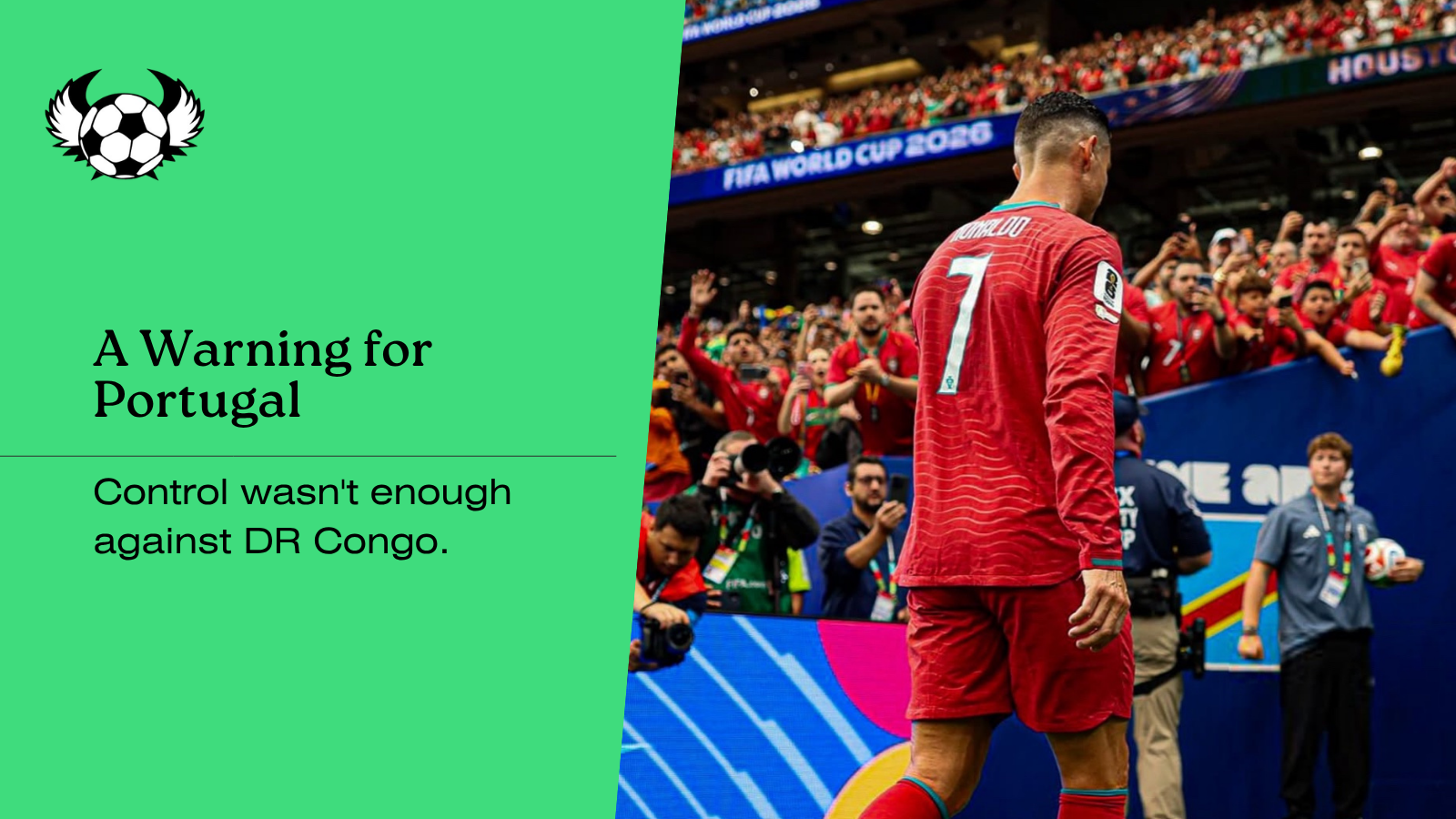
Portugal arrived at the 2026 FIFA World Cup carrying the expectations that naturally follow one of the tournament’s strongest squads. Roberto Martínez’s side entered Group K as favourites to qualify and many expected the opening match against DR Congo to provide a comfortable start.
Embed from Getty ImagesInstead, the Portugal vs Congo clash delivered one of the early surprises of the tournament.
João Neves gave Portugal the perfect opening when he scored after just six minutes, but the advantage did not last. DR Congo gradually grew into the contest and found an equaliser through Yoane Wissa before half-time. Portugal controlled possession for long periods but struggled to create enough clear opportunities to restore their lead.
Embed from Getty ImagesOn paper, a 1-1 draw is not a disastrous result. Portugal remain well placed to reach the knockout rounds. However, World Cups are rarely decided by reputation alone. Opening matches often reveal important truths about a team, and this performance highlighted both the strengths and weaknesses within Portugal’s squad.
The bigger story is not simply the Portugal score. It is what the performance tells us about Portugal’s chances of making a deep run in North America.
How Group K Looks After Portugal vs Congo
Updated Group K Standings
After the first round of matches, Colombia occupy top spot following their victory over Uzbekistan. Meanwhile, Portugal and the DR Congo national football team sit level on one point after sharing the spoils in Houston.
| Position | Team | Played | Points | GF | GA | GD |
|---|---|---|---|---|---|---|
| 1 | Colombia | 1 | 3 | 3 | 1 | +2 |
| 2 | Portugal | 1 | 1 | 1 | 1 | 0 |
| 3 | DR Congo | 1 | 1 | 1 | 1 | 0 |
| 4 | Uzbekistan | 1 | 0 | 1 | 3 | -2 |
For Portugal, the frustration stems from the fact that they were in control early. Neves’ goal should have provided a platform for a routine victory. Instead, DR Congo responded impressively and earned a historic point in their first World Cup appearance since 1974.
From the Congolese perspective, the result represents a landmark moment. Wissa’s equaliser delivered the country’s first World Cup goal since returning to the tournament and immediately strengthened their hopes of competing for qualification.
What the Result Means for Qualification
The expanded 48-team World Cup format gives teams more room for error than previous tournaments. The top two teams in each group qualify automatically for the Round of 32, while several third-placed sides can also advance.
Therefore, Portugal’s campaign remains firmly on track.
That said, the draw has removed any early cushion. A victory would have allowed Martínez’s side to approach the remaining fixtures with considerably less pressure. Now, the meeting with Uzbekistan takes on greater importance.
A win in Matchday Two would move Portugal onto four points and place them in a strong position heading into the final group game against Colombia. Anything less would increase the pressure considerably.
The encouraging news for Portugal supporters is that qualification remains entirely within their control. The concern is whether stronger opponents later in the competition could expose some of the issues seen against DR Congo.
Portugal Controlled the Ball But Not the Match
One of the most striking aspects of the Portugal vs DR Congo World Cup 2026 encounter was the contrast between possession and attacking threat.
Portugal spent long stretches circulating the ball through midfield. Players such as João Neves, Vitinha and Bruno Fernandes saw plenty of possession and rarely looked uncomfortable under pressure.
Yet domination of the ball did not translate into domination of the scoreboard.
DR Congo remained disciplined defensively. Rather than chasing possession, they focused on protecting central areas and limiting the space available between the lines. Portugal often moved the ball efficiently, but too much of their possession occurred away from dangerous areas.
This is a recurring challenge for possession-based teams in tournament football.
At club level, superior technical quality often overwhelms opponents over the course of a season. International tournaments are different. Teams have limited preparation time, matches carry enormous stakes, and underdogs are often content to defend patiently.
Portugal looked comfortable for much of the evening. They rarely looked threatening enough.
That distinction matters.
Championship-winning sides do not simply control games. They create enough quality chances to punish opponents. Against DR Congo, Portugal fell short in that area.
Cristiano Ronaldo’s Role Continues to Evolve
A Different Version of Ronaldo
Every major tournament involving Cristiano Ronaldo inevitably sparks the same conversation: can he still decide matches at the highest level?
The answer is increasingly complex.
At 41, Ronaldo is no longer the player who could dominate every phase of a game through explosive movement and relentless attacking runs. That version of the Portugal captain belongs to a different era.
However, reducing his contribution to goals alone misses a significant part of his value to the Portugal national football team.
Against DR Congo, Ronaldo often operated as a focal point rather than a creator. His positioning occupied defenders and provided a reference point for Portugal’s attacking structure. The problem was not necessarily his movement. The problem was the limited quality of service reaching him.
Several of Portugal’s attacks broke down before they reached dangerous areas. Crosses lacked precision, passing combinations became predictable, and DR Congo’s defensive organisation prevented Ronaldo from receiving the ball in positions where he could have the greatest impact.
The Bigger Issue Was Creativity
It would be easy to focus on Ronaldo’s lack of goals and conclude that Portugal’s attack struggled because their captain had a quiet evening.
The reality is more nuanced.
Portugal’s forwards were largely starved of opportunities. Ronaldo certainly had moments he would expect to do better with, but he was far from the only attacker affected by Portugal’s lack of creativity.
The midfield trio controlled possession effectively. What they did not consistently provide was penetration.
Bruno Fernandes produced several promising passes. Pedro Neto attempted to inject pace and directness. Yet the overall attacking structure lacked the unpredictability needed to unsettle DR Congo’s defensive block.
As a result, Ronaldo spent too much time waiting for chances rather than finishing them.
Leadership Still Matters
One aspect that statistics rarely capture is leadership.
World Cups place extraordinary psychological demands on players. Momentum can shift quickly. Pressure intensifies with every match.
Ronaldo remains one of the most experienced players in international football history. His presence alone carries value inside a squad filled with younger talents such as João Neves and Francisco Conceição.
Portugal no longer need Ronaldo to carry the team single-handedly. They need him to provide goals when opportunities arise, leadership when challenges emerge, and composure when the stakes increase.
The opening match suggested that responsibility is increasingly shared across the squad.
That may ultimately benefit Portugal as the tournament progresses.
Three Portugal Players Who Enhanced Their Standing Against DR Congo
While the result left Portugal frustrated, not every takeaway from Houston was negative.
Several players emerged with their reputations strengthened, even on a night when the team failed to secure all three points. In fact, some of Portugal’s most encouraging performances came from players who could become increasingly important as the World Cup progresses.
João Neves Continued His Rise as Portugal’s Midfield Leader
If Portugal were searching for a clear positive from the draw, they found it in João Neves.
The 21-year-old midfielder scored Portugal’s opening goal after just six minutes and remained one of the team’s most influential players throughout the match. More importantly, his performance highlighted qualities that extend well beyond goals.
Neves consistently made himself available in possession, helped Portugal progress the ball through midfield, and displayed the composure of a player far more experienced than his age suggests.
What stood out most was his decision-making.
World Cup football can often expose younger players. The pace is quicker, mistakes are punished more severely, and pressure arrives from every direction. Neves looked entirely unfazed.
When Portugal needed control, he provided it. When they needed energy, he supplied that too.
Roberto Martínez has no shortage of midfield talent, but performances like this reinforce why Neves has become such a crucial figure in the current setup.
If Portugal are to challenge for the latter stages of the tournament, Neves is likely to be central to that effort.
Bruno Fernandes Remains Portugal’s Creative Engine
Every successful international side needs a player capable of unlocking compact defensive structures.
For Portugal, that player remains Bruno Fernandes.
The Manchester United midfielder was once again the team’s primary source of creativity. Whenever Portugal managed to move the ball into dangerous areas, Fernandes was usually involved somewhere in the sequence.
His ability to receive possession between the lines remains one of Portugal’s most valuable weapons.
Even against a disciplined DR Congo defence, Fernandes continued searching for progressive passes and attacking openings. While not every attempt came off, he remained Portugal’s most consistent creative threat.
The match also highlighted a broader issue.
Portugal still depend heavily on Fernandes when it comes to chance creation.
That reliance is not necessarily a weakness. Many elite teams are built around a primary creator. However, stronger opponents may target Fernandes specifically, forcing other players to shoulder more creative responsibility.
Against DR Congo, he largely carried that burden alone.
Portugal will hope others can share it in future matches.
Vitinha Controlled the Rhythm of the Match
Some performances attract headlines. Others quietly shape the entire game.
Vitinha belonged firmly in the second category.
The Paris Saint-Germain midfielder may not have scored or produced a decisive assist, but his influence on Portugal’s overall performance was significant.
Whenever Portugal established long spells of possession, Vitinha was usually at the centre of it.
His ability to receive under pressure, recycle possession, and dictate tempo helped Portugal maintain territorial control throughout much of the match.
This role can sometimes be overlooked because it rarely produces highlight-reel moments. Yet tournament football often hinges on midfielders capable of controlling the pace of games.
Vitinha excels in exactly that area.
The challenge moving forward is ensuring that Portugal’s control leads to greater attacking output.
Against DR Congo, the platform existed. The final product did not always follow.
What Portugal Still Need to Improve
Possession Must Lead to More Chances
Portugal’s biggest issue against DR Congo was not defending.
Nor was it a lack of technical quality.
The real problem was efficiency.
Large periods of possession failed to produce enough meaningful opportunities. The midfield controlled territory, but Portugal rarely forced the Congolese defence into sustained periods of panic.
This is where the difference between controlling a match and winning it becomes important.
Elite international teams know how to transform dominance into chances.
Portugal spent too much time circulating possession in safe areas rather than consistently attacking dangerous spaces.
Against stronger opponents later in the competition, that could become costly.
More Variety Is Needed in Attack
One reason DR Congo defended so effectively was predictability.
Portugal often attempted to build through similar areas and relied heavily on the same creative outlets.
When Fernandes dropped deeper to receive possession, attacks frequently flowed through him. While his quality is unquestionable, tournament football rewards teams that can threaten opponents in multiple ways.
At times, Portugal lacked that variety.
The squad certainly possesses the necessary tools.
Players such as Pedro Neto, Rafael Leão, Francisco Conceição and João Cancelo all bring different attacking qualities. The challenge for Martínez is finding the right balance between structure and spontaneity.
The best international sides remain difficult to predict.
Portugal occasionally looked too easy to read.
Better Service for Ronaldo and the Forwards
Discussion surrounding Cristiano Ronaldo will inevitably dominate headlines, but the broader issue extends beyond one player.
Portugal’s entire forward line needs better service.
Whether Ronaldo starts, or whether Martínez rotates options later in the tournament, attackers depend on quality deliveries into dangerous areas.
Against DR Congo, those deliveries arrived too infrequently.
Crosses often lacked precision. Through balls were limited. Combination play around the penalty area rarely stretched the opposition defence.
Consequently, Portugal’s forwards spent long periods waiting for opportunities that never fully materialised.
Improving those connections between midfield and attack could make a substantial difference over the next two matches.
Why the Draw May Be Useful
Strange as it sounds, Portugal may ultimately benefit from this result.
Opening-match victories can sometimes mask underlying problems. Teams leave with three points and fewer questions, even when performances are imperfect.
A draw creates a different environment.
It forces reflection.
Martínez and his coaching staff now have clear evidence of the areas requiring attention before the knockout rounds begin. The shortcomings against DR Congo were visible, but they were also fixable.
Portugal did not look physically overwhelmed.
They did not appear tactically outclassed.
Nor did they struggle to control possession.
Instead, the issues largely centred around chance creation, attacking fluidity, and efficiency in the final third.
Those are concerns that can often be addressed more easily than structural defensive weaknesses.
There is also a wider tournament context worth considering.
Many eventual World Cup contenders have opened tournaments slowly before finding their rhythm later on. International competitions are rarely won in the first match. They are won by teams that improve as the tournament progresses.
Portugal now face exactly that challenge.
The draw against DR Congo was disappointing, but it was far from damaging.
The next two matches will reveal whether it was simply an early stumble or a warning sign of deeper issues.
What Comes Next for Portugal?
Portugal vs Uzbekistan Has Become a Must-Win Fixture
The immediate focus for the Portugal national football team now shifts to Uzbekistan.
While it would be inaccurate to describe the match as do-or-die, it has undoubtedly become one of the most important games of Portugal’s group-stage campaign.
Before the tournament began, many expected Portugal to collect six points from their opening two fixtures before facing Colombia. The draw with DR Congo has changed that equation.
A victory over Uzbekistan would move Portugal onto four points and restore momentum ahead of the final group match. It would also significantly strengthen their chances of reaching the knockout rounds regardless of other results in Group K.
Conversely, another draw would leave qualification unresolved and place enormous emphasis on the Colombia fixture.
Defeat would create a genuinely difficult situation.
That scenario remains unlikely given Portugal’s superior quality on paper. Nevertheless, World Cups have a habit of punishing teams that fail to learn from early setbacks.
Martínez will expect a response.
Key Areas to Watch
The most interesting aspect of Portugal’s next match may not be the result itself, but how the team approaches it.
Will Martínez stick with the same attacking structure?
Will he ask Bruno Fernandes to play higher up the pitch?
Could Rafael Leão or Francisco Conceição take on a larger role?
These are the questions that emerged following the draw against DR Congo.
Portugal do not need wholesale tactical changes. Their midfield functioned well, and their defensive structure remained largely solid.
However, a slight increase in tempo, directness, and attacking variety could make a substantial difference.
Against Uzbekistan, the focus will likely be on turning possession into chances more efficiently than they managed in Houston.
The Colombia Match Looms Large
Even if Portugal defeat Uzbekistan, the final group-stage clash with Colombia could still determine who finishes top of Group K.
That matters.
Winning the group often provides a more favourable route through the knockout stages. While tournament football rarely follows a predictable script, group winners typically avoid facing some of the strongest teams immediately after the group phase.
Portugal therefore have two objectives.
The first is qualification.
The second is positioning themselves for a deeper run through the tournament.
The performance against DR Congo made the first objective slightly harder. The second remains entirely achievable.
Conclusion: Portugal’s World Cup Ambitions Remain Intact
The Portugal vs Congo result was not the start many expected, but it would be a mistake to overreact to a single group-stage draw.
There were frustrations, certainly.
Portugal took an early lead through João Neves and never fully capitalised on their control of possession. Their attack lacked the sharpness expected from a squad containing players such as Bruno Fernandes, Rafael Leão, Pedro Neto, and Cristiano Ronaldo. As a result, DR Congo earned a deserved point and created one of the early stories of the tournament.
Yet there were positives too.
Neves produced one of the best performances of his international career. Vitinha controlled large portions of the game from midfield. Fernandes remained Portugal’s primary creative force. Most importantly, Portugal still showed many of the qualities associated with successful tournament teams: composure, technical quality, and the ability to control possession under pressure.
The draw does not significantly damage Portugal’s qualification prospects.
What it does is highlight areas that require improvement.
The challenge now is converting territorial dominance into genuine attacking threat. If Martínez can solve that issue, Portugal will remain one of the more dangerous teams in the competition.
World Cups are rarely won with perfect starts.
Sometimes they are won by teams that learn quickly from imperfect ones.
For Portugal, the next few matches will reveal which category this squad belongs to.
If they combine the experience of Cristiano Ronaldo and Bruno Fernandes with the energy of emerging stars such as João Neves and Vitinha, the Portugal football team still has every reason to believe it can make a deep run at the 2026 FIFA World Cup.