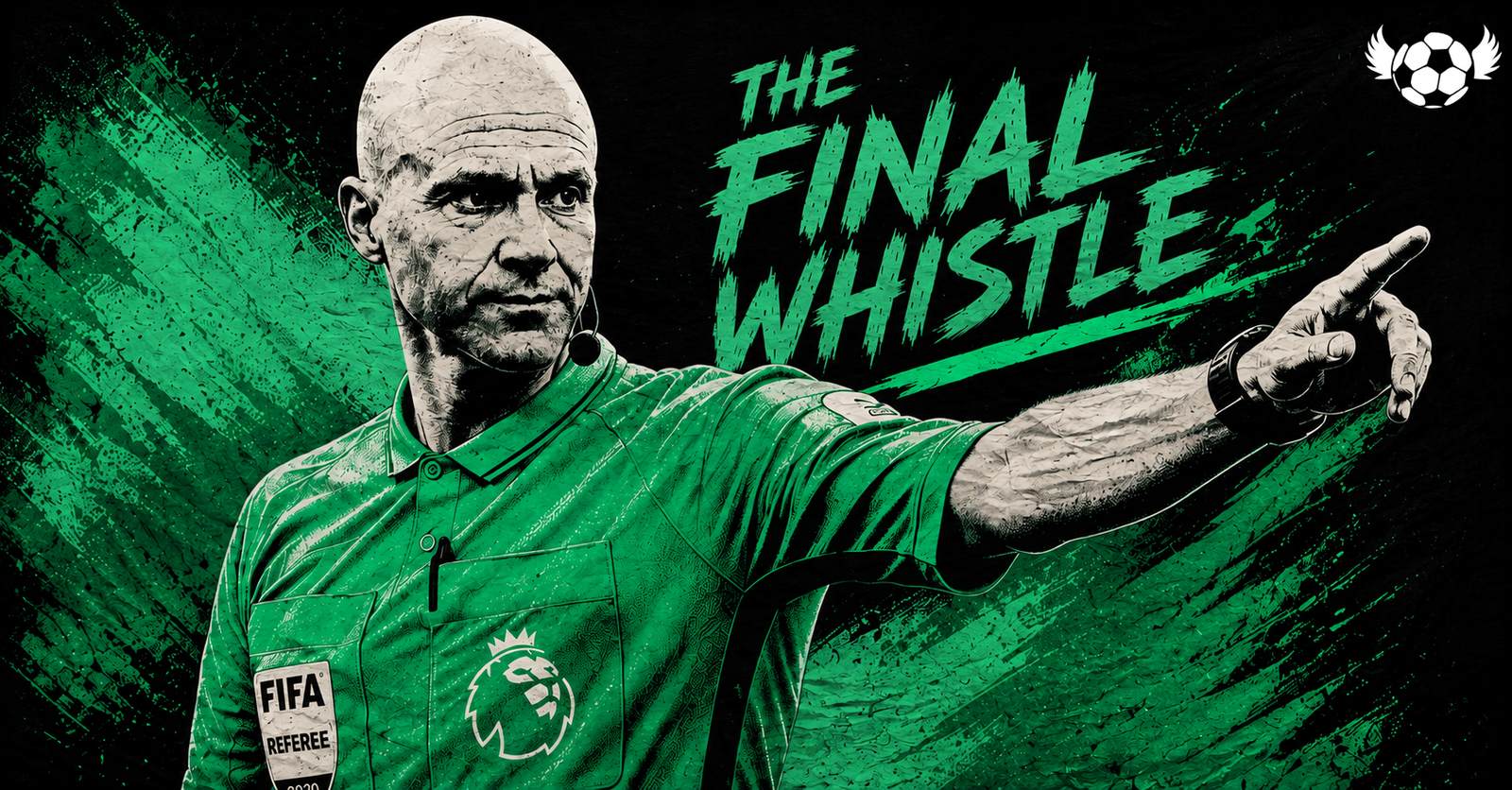
Anthony Taylor retires after one of the defining refereeing careers of the modern era. After 24 years as a match official and 16 seasons in the Premier League, the Englishman has stepped away from elite officiating following the 2026 FIFA World Cup, ending a career that took him from England’s lower leagues to the biggest stages in world football.
His final assignment came in the World Cup round-of-16 tie between Spain and Portugal on 6 July 2026 before PGMOL and England Football confirmed his retirement on 21 July. By then, Taylor had overseen 432 Premier League matches, officiated major domestic and European finals, and represented England at two FIFA World Cups.
Yet his career cannot be measured solely by appointments or statistics. It was shaped by moments of extraordinary composure, fierce public criticism and the relentless scrutiny that defines modern refereeing. Throughout it all, football’s governing bodies continued to trust him with the game’s biggest occasions.
Taylor’s retirement therefore marks more than the end of an individual career. It offers an opportunity to examine how a former prison officer rose to the summit of world refereeing, why he remained one of football’s most trusted officials despite persistent controversy, and what his career reveals about the demands of elite officiating in the modern game.
How Anthony Taylor rose from prison officer to elite referee
Taylor’s route to the top of football was anything but conventional. Before becoming a full-time referee, he worked as a prison officer at HMP Manchester while building his officiating career in English non-league football.
His rise through the refereeing pyramid came steadily. After beginning in the Northern Premier League between 2002 and 2004, he progressed to Conference North before joining the Football League list of referees in 2006, taking charge of his first league fixture between Wrexham and Peterborough United.
His Premier League breakthrough arrived in February 2010 when he officiated Fulham’s 1-0 victory over Portsmouth. Promotion to the Select Group followed the next season, establishing him as a regular in England’s top flight.
International recognition came in 2013 with his inclusion on FIFA’s International List, opening the door to UEFA and FIFA competitions alongside an expanding domestic profile.
Within a few years, Taylor had become one of English football’s leading officials. He refereed the 2015 League Cup Final and Community Shield before taking charge of his first FA Cup Final in 2017. Three years later, PGMOL appointed him to a second FA Cup Final, making him the first referee since 1901 to receive the honour twice.
His reputation continued to grow internationally. UEFA selected him for the 2020 Super Cup and the 2021 Nations League Final, while FIFA entrusted him with the 2022 Club World Cup Final and appointments at both the 2022 and 2026 World Cups.
By the time he retired, Taylor had officiated 831 professional matches across domestic and international football, completing one of the most distinguished refereeing careers of his generation.
Anthony Taylor’s biggest refereeing appointments
Elite referees are judged not only by individual performances but also by the confidence placed in them by football’s governing bodies. Few English officials received that confidence as consistently as Taylor.
Across 16 Premier League seasons, he refereed 432 matches while also taking charge of virtually every major domestic occasion, including two FA Cup Finals, the League Cup Final, the Community Shield and the Championship play-off final.
His international résumé was equally impressive. Taylor officiated 42 UEFA Champions League matches, finishing his career as the second-most experienced English referee in the competition behind Michael Oliver. UEFA also selected him for the Super Cup, Nations League Final and the 2023 Europa League Final, while FIFA appointed him to two World Cups, two Club World Cups and numerous high-profile international fixtures.
Those appointments reflected more than longevity. They demonstrated sustained confidence from PGMOL, UEFA and FIFA that Taylor could manage football’s highest-pressure matches.
Howard Webb, PGMOL’s Chief Refereeing Officer, described him as “one of the best and most successful officials that English football has ever produced”, praising both his professionalism and the trust he repeatedly earned on the sport’s biggest stages.
That institutional backing formed one of the defining themes of Taylor’s career. While individual decisions frequently divided supporters, football’s governing bodies consistently viewed him as an official capable of handling elite-level football under the greatest pressure.
Those appointments also created the moments that ultimately defined his career, from extraordinary acts of composure to some of the most intensely debated matches of the modern era.
Five matches that defined Anthony Taylor’s career
Every elite referee has matches that shape how they are remembered. For Anthony Taylor, those moments ranged from a medical emergency that transcended football to major finals and World Cup appointments that tested his authority under immense pressure.
No fixture defined his career more than Denmark’s UEFA Euro 2020 meeting with Finland on 12 June 2021. Football became secondary when Christian Eriksen collapsed after suffering a cardiac arrest late in the first half.
Taylor immediately recognised the severity of the situation, stopped play within seconds and urgently summoned medical staff onto the pitch. His swift response was widely praised by FIFA, UEFA and the medical community, with official reports and widespread coverage crediting his calm intervention as an important part of the emergency response that helped save Eriksen’s life.
For perhaps the only time in his career, Taylor became the subject of universal admiration. The incident elevated him beyond the role of a referee making split-second sporting decisions and established him as an example of composure during an extraordinary human crisis. Within refereeing circles, his handling of the emergency has since become a teaching model for crisis management and situational awareness.
If Denmark against Finland represented Taylor at his most admired, the 2023 UEFA Europa League Final between Sevilla and Roma illustrated the relentless scrutiny that accompanies elite officiating.
The fractious final finished 1-1 before Sevilla won on penalties. Taylor issued 13 yellow cards, overturned a penalty following a VAR review and ordered the decisive penalty to be retaken because of goalkeeper encroachment.
Roma manager José Mourinho launched fierce criticism after the match, while Taylor and his family were later harassed by supporters at Budapest Airport. Despite the public backlash, UEFA concluded that he had committed no major technical errors, reinforcing the contrast between institutional assessment and public reaction.
Another landmark came in the 2017 FA Cup Final between Arsenal and Chelsea. Taylor overruled his assistant’s offside flag to allow Alexis Sánchez’s opening goal before later dismissing Chelsea’s Victor Moses for simulation after a second yellow card.
Those decisions under intense scrutiny demonstrated his willingness to make difficult calls on England’s biggest domestic stage and strengthened his standing within PGMOL, ultimately contributing to his unprecedented second FA Cup Final appointment in 2020.
A different kind of milestone followed in September 2024 when Bournemouth hosted Chelsea. Taylor issued a modern Premier League record 14 yellow cards to players, as well as cautions for both managers, during a fiercely contested match.
Supporters of his approach viewed the performance as evidence of firm control over an increasingly physical contest. Critics argued he had over-officiated a game that could have been managed with a lighter touch. The fixture encapsulated the debate that followed him throughout much of his career.
Taylor’s final defining appointment arrived on 6 July 2026 when FIFA selected him to referee Spain’s World Cup round-of-16 meeting with Portugal.
Entrusted with one of the tournament’s marquee knockout fixtures, he oversaw Spain’s 1-0 victory before bringing a distinguished international career to a close. It was a fitting farewell for an official whose career had repeatedly been measured by the scale of the matches he was chosen to officiate.
Taken together, these five fixtures capture the breadth of Taylor’s career. They reveal an official capable of remaining calm in moments of genuine human crisis, managing football’s biggest occasions and accepting the scrutiny that inevitably accompanies refereeing at the highest level.
Anthony Taylor’s most controversial decisions
Taylor’s career was built on the confidence of football’s governing bodies, but it unfolded during an era when every major decision was dissected by broadcasters, supporters and social media. Like many elite referees, he became a polarising figure.
Among Chelsea supporters, criticism intensified after he sent off Reece James against Liverpool in August 2021 for a goal-line handball following a VAR review. Many argued the ball had deflected from James’s thigh onto his arm, fuelling a long-running perception among sections of the fanbase that Taylor treated the club unfairly. The reaction eventually led to online petitions calling for him to be removed from Chelsea fixtures.
Taylor faced another flashpoint at the 2022 FIFA World Cup when he ended South Korea’s defeat to Ghana immediately after their final attack, denying the team one last corner. The decision sparked furious protests from players and staff, while head coach Paulo Bento was shown a red card after the final whistle.
The Europa League Final generated the most personal consequences of Taylor’s career. Roma believed they should have received a late penalty for handball, but Taylor, supported by his VAR team, ruled that the defender’s arm was in a natural position. UEFA later confirmed that assessment and concluded he had made no major technical errors, while Mourinho received a four-match ban for his conduct. Nevertheless, the abuse directed at Taylor and his family after the match became one of the defining off-field episodes of his career.
Not every controversial decision received institutional backing.
In October 2023, Taylor awarded Newcastle United a penalty against Wolverhampton Wanderers after ruling that Hwang Hee-chan had fouled Fabian Schär. PGMOL’s Independent Key Match Incidents Panel later judged the decision to be incorrect, while Howard Webb publicly stated that VAR should have intervened. Taylor was appointed to a Championship fixture rather than a Premier League match the following weekend.
Another major error was acknowledged after UEFA Euro 2024. During Germany’s quarter-final against Spain, Taylor waved away appeals after Jamal Musiala’s shot struck Marc Cucurella’s hand in extra time. Months later, UEFA’s Referees Committee issued a technical update confirming that a penalty should have been awarded under the competition’s handball guidelines.
The record 14 yellow cards shown during Bournemouth’s meeting with Chelsea also divided opinion. While critics argued the volume of cautions reflected excessive officiating, PGMOL’s post-match review supported Taylor’s application of the Laws of the Game, concluding that the players’ actions warranted each booking.
These episodes illustrate why Taylor remained one of football’s most debated referees. Public reaction often focused on individual decisions, while football’s governing bodies continued to judge his overall performances highly enough to entrust him with the sport’s biggest occasions.
Understanding Anthony Taylor’s refereeing style
Taylor’s refereeing style was built on structure, authority and consistency. Influenced by his background as a prison officer, he developed a reputation for setting clear behavioural boundaries rather than relying on personality or prolonged dialogue to manage matches.
His approach generally favoured early intervention over allowing games to become increasingly physical. Rather than hoping players would settle themselves, Taylor often used his whistle proactively to prevent situations from escalating. His application of the advantage rule was similarly measured, with play usually brought back if a promising attack failed to develop quickly.
Disciplinary control became another hallmark of his officiating. Throughout much of his career, his yellow-card figures broadly aligned with European norms, although his final seasons saw an increase in cautions as football’s authorities introduced stricter directives on dissent, tactical fouls and player behaviour. The record 14 yellow cards shown during Bournemouth’s meeting with Chelsea illustrated that evolution.
Former players and refereeing observers frequently described Taylor as direct and businesslike in his communication. He generally kept conversations brief, expected captains to help manage their teammates and responded firmly when behaviour crossed accepted limits.
The arrival of VAR in 2019 also influenced his work. Taylor spoke publicly about the technology creating what he described as an unrealistic “expectation of perfection”, while adapting his positioning to make use of video review as an additional layer of support.
Critics sometimes viewed his style as overly rigid, particularly during controversial matches. Supporters pointed to those same qualities as reasons why PGMOL, UEFA and FIFA repeatedly selected him for football’s biggest occasions. His handling of Christian Eriksen’s medical emergency, together with his management of numerous domestic and international finals, reinforced that confidence.
A career measured by trust
Taylor’s longevity alone places him among the Premier League era’s most significant referees.
Across 24 years in professional football, he officiated 831 matches, including 668 domestic fixtures in England and 163 international appointments. Of those, 432 came in the Premier League across 16 seasons, making him one of the competition’s most experienced officials.
His disciplinary record reflected both the demands of elite officiating and his approach to match management. Taylor issued more than 2,600 yellow cards, averaging between 3.58 and 3.78 cautions per game, alongside around 70 dismissals and 187 penalties across all competitions.
His experience also spanned 23 different competitions, from every major domestic tournament in England to UEFA club competitions and FIFA’s biggest international events.
Compared with other leading Premier League referees, his standing becomes even clearer. Only Mike Dean and Martin Atkinson officiated more Premier League matches, while Taylor narrowly finished ahead of long-time contemporary Michael Oliver in top-flight appearances. His appointments to two FIFA World Cups, two European Championships and multiple continental finals further underline the confidence placed in him throughout his career.
Statistics, however, explain only part of his legacy. More significant was the repeated willingness of football’s governing bodies to entrust him with their highest-profile fixtures, even after controversial moments that dominated headlines.
How football should remember Anthony Taylor
Anthony Taylor leaves football with one of the most accomplished refereeing careers of the modern era.
His résumé includes virtually every major domestic honour available to an English referee, appointments to Europe’s biggest finals and two FIFA World Cups. He spent 14 years on FIFA’s International List and earned the confidence of PGMOL, UEFA and FIFA across more than two decades.
His legacy extends well beyond appointments.
His immediate response to Christian Eriksen’s cardiac arrest at Euro 2020 remains one of the defining moments of modern refereeing, demonstrating that the role demands far more than applying the Laws of the Game. Within officiating circles, the incident continues to serve as a benchmark for crisis management and situational awareness.
Away from the pitch, Taylor also earned praise as a mentor to younger officials. Howard Webb highlighted his professionalism, character and willingness to support the next generation, while colleagues frequently described him as a calm and generous presence within refereeing.
His career also highlighted the darker realities of modern football. The abuse directed at Taylor and his family following the 2023 Europa League Final became a stark reminder of the personal consequences elite referees can face when high-profile decisions become emotionally charged public debates.
Public opinion is likely to remain divided. Some supporters will remember controversial decisions involving their clubs, while others will recall matches in which his authority and composure earned widespread praise.
Football’s governing bodies, however, consistently delivered the clearest verdict through their actions. Time and again, they selected Taylor for the sport’s biggest occasions because they believed he remained one of England’s finest officials.
Ultimately, Anthony Taylor should not be remembered solely through the lens of individual controversies. His career reflected the extraordinary demands placed upon modern referees: the expectation of near-perfect judgement, the scrutiny of every decision and the resilience required to continue performing at the highest level despite relentless criticism.
When he walked away after his final World Cup assignment, Taylor did so having officiated some of football’s biggest matches and earned the enduring trust of the authorities responsible for appointing them.