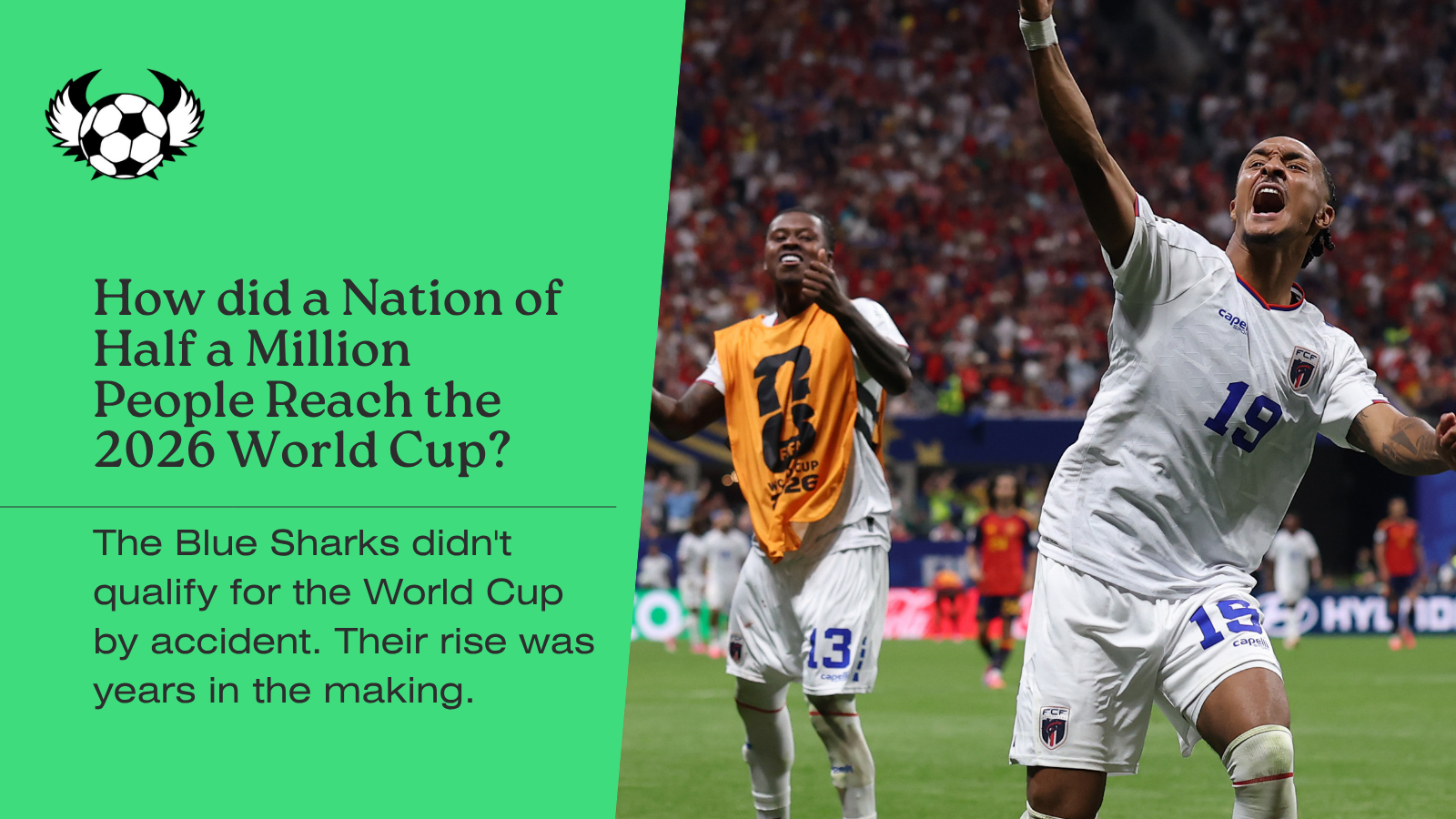
The Blue Sharks didn’t qualify for the World Cup by accident. Their rise was years in the making.
Embed from Getty ImagesA Nation Rewrites History
When the final whistle blew in Praia on October 13, 2025, thousands of supporters spilled into the streets. Car horns ran for twenty minutes through the capital’s Plateau district. Across the Atlantic, the Cape Verdean community centres in Rotterdam and Boston had been hosting watch parties since kick-off. When the moment came, the footage from both cities looked identical to the footage from the islands: people who had never met each other, reacting to the same result in the same way.
Cape Verde had qualified for the FIFA World Cup for the first time in the nation’s history.
For many football fans, the achievement seemed almost impossible to place in context. Cape Verde, officially Cabo Verde, is a volcanic archipelago of ten islands located around 570 kilometres off the coast of West Africa. With a population of approximately 525,000 people, it is the second-smallest country by population ever to reach football’s biggest stage, surpassed only by Iceland, who made their World Cup debut in 2018.
Yet qualification was not the result of a lucky draw or a fortunate run of results. Cape Verde finished above traditional African heavyweights including Cameroon, collecting 23 points from a possible 30 across ten matches. That is not a team catching momentum at the right moment. That is a system working across a full campaign.
The story of the Blue Sharks is not simply an underdog story. It is a lesson in long-term planning, smart recruitment, tactical discipline, and the strategic use of a diaspora that outnumbers the domestic population several times over.
The Second-Smallest Nation at the Tournament
The 2026 FIFA World Cup expanded to 48 teams, creating additional qualification pathways for nations that had previously been squeezed out. Even accounting for that expansion, Cape Verde’s achievement is extraordinary.
Countries with far greater populations, deeper footballing traditions, and significantly larger budgets failed to qualify. Cameroon, with eight previous World Cup appearances and the most of any African nation, finished behind them. That result was not an accident of scheduling or a single bad performance. Cape Verde beat Cameroon home and away across the campaign, and their aggregate points tally reflected consistent superiority, not a fortunate points swing late in the group.
Football history is dominated by a familiar set of giants. Brazil, Germany, Argentina, France, and Spain have shaped generations of World Cup narratives. Cape Verde’s qualification sits at the opposite end of that spectrum, representing a nation smaller in population than many football club fanbases, competing in a tournament designed for continental powers.
Reducing their achievement to population statistics, however, misses the structural argument entirely. This qualification was not a miracle. It was the cumulative output of more than a decade of incremental decisions, structural, tactical, and demographic, that most observers only noticed when the final whistle blew in Praia.
How Cape Verde Beat Cameroon to Qualification
Cape Verde’s campaign was built on a specific competitive identity rather than on individual brilliance.
Across ten matches, the Blue Sharks won seven, drew two, and lost once. They conceded eight goals across the full campaign, including a 4-1 defeat to Cameroon on the road. That away defeat looked damaging in isolation. In the context of the full group, it was an anomaly the team absorbed without losing structural momentum.
The number that defines the campaign more accurately is zero. Cape Verde kept a clean sheet in all five home qualification matches, winning every one of them. In Praia, they were not merely difficult to beat. They were impenetrable. Opponents arrived, found the central corridors closed, were funnelled wide, and left without scoring.
While Cameroon entered the campaign as group favourites on the strength of their historical pedigree, pressure shifted progressively onto them as Cape Verde accumulated points without drama. By the time the final qualifying window arrived, Cameroon needed results to go their way. Cape Verde needed only to do what they had been doing all campaign.
The decisive match arrived in October 2025: a 3-0 home victory against Eswatini that confirmed qualification and left Cape Verde four points clear at the top of the group. When the final whistle blew, the formalities of celebration felt almost secondary to what the scoreline confirmed structurally. Five wins from five at home. Zero goals conceded on their own ground. One group finished and one nation’s footballing history permanently altered.
Bubista’s Tactical Blueprint
Every successful international side has an identity. Cape Verde’s came from organisation rather than star power, and the architect of that organisation was head coach Pedro “Bubista” Brito, a former Cape Verde international who took over as coach in 2020 and spent five years converting a competitive but inconsistent side into one of Africa’s most disciplined defensive units.
Rather than attempting to dominate possession against stronger opponents, Bubista built a system, typically a 4-2-3-1 with a 4-1-4-1 variant deployed against specific opponents, around four interlocking principles.
Defensive compactness. Cape Verde’s midfield block remained narrow throughout matches, protecting central corridors and directing opponents into wide positions where crossing opportunities could be managed more predictably. That structural discipline is what produced the perfect home clean-sheet record during qualification. It was not a series of individual goalkeeping performances but a collective shape that repeatedly made the same type of chance available and repeatedly dealt with it the same way.
High pressing. Rather than sitting deep and allowing opponents to build, Cape Verde used coordinated forward pressure to win possession in advanced positions before attacks could develop. The pressing was triggered rather than continuous. Specific player movements and ball positions activated the press rather than a permanent instruction to chase, which preserved energy across 90 minutes and kept the defensive structure intact when the press was not engaged.
Quick transitions. When possession was won, the ball moved forward rapidly through pace and direct running rather than through extended passing sequences. This allowed Cape Verde to create chances without needing territorial dominance, a crucial advantage for a side that will rarely control a match against stronger opposition.
Collective responsibility. Unlike international teams constructed around one or two individual talents, Cape Verde’s effectiveness depended on every player understanding their role within the defensive and transitional structure. That collective clarity became the team’s most consistent competitive advantage across the qualification campaign.
More Than a Small Country: The Diaspora Advantage
One of the most structurally significant aspects of Cape Verde’s football story operates far from the islands themselves.
Cape Verde’s global diaspora is substantially larger than its domestic population, with established communities across generations in Portugal, the Netherlands, France, Luxembourg, and the United States. For football, this has become a recruitment infrastructure that no domestic programme of Cape Verde’s size could otherwise access.
The mechanism is straightforward. Players born to Cape Verdean families in Rotterdam, Lisbon, or Boston enter European academies and professional development systems from youth level. They develop within elite coaching environments and compete at levels far above what Cape Verdean domestic football can provide. The national team then draws on that accumulated European development when those players reach international age, effectively importing a decade of elite youth coaching that the federation did not need to fund or build itself.
After the near-miss of the 2022 qualifying campaign, the federation formalised what had previously been an informal advantage. Scouting pipelines into the Portuguese second division and the Dutch lower leagues, where diaspora communities are densest, became structured rather than opportunistic. The relationship between the domestic federation and diaspora clubs in Rotterdam and Lisbon became a systematic feature of player identification rather than a happy accident. Bubista’s continuity as coach across multiple qualification cycles meant that players identified through those pipelines were integrated into a consistent tactical identity rather than introduced to a new system each campaign.
For many players, representing the Blue Sharks carries meaning beyond the match itself. It is an opportunity to reconnect with family heritage and cultural identity across generations of distance. That emotional investment does not replace tactical organisation, but it reinforces the collective cohesion that Bubista’s system requires. The team represents not only the islands but the hundreds of thousands of Cape Verdeans and their descendants living in communities that the World Cup stage will now make visible to an audience those communities rarely reach.
The Long Road to the World Cup
Cape Verde joined FIFA in 1986. For the first two decades of their membership, qualification for any major tournament felt remote.
Progress came in increments. The 2013 Africa Cup of Nations was the first real signal. Cape Verde qualified for the tournament and reached the quarter-finals on debut, defeating Angola along the way and signalling an organisational maturity that had not previously been associated with the Blue Sharks. AFCON appearances followed in 2015 and 2023, with the 2023 edition again ending at the quarter-final stage, confirming that the 2013 run had not been an outlier.
The most significant developmental moment came in 2022. Cape Verde entered the final qualifying window for the Qatar World Cup needing a result and fell short on the final matchday, eliminated not through structural failure but through the marginal arithmetic of a group that went to the wire. The near-miss was the kind of result that either breaks a programme’s belief or confirms it. For Cape Verde, it confirmed that the system was operating at World Cup level. The question was whether it could sustain that level across another full qualifying campaign.
The answer arrived in October 2025, four points clear at the top of the group.
Holding Spain: The World Cup Arrival
Embed from Getty ImagesThe World Cup draw placed Cape Verde in a group containing Spain, the reigning European champions and among the tournament favourites, alongside Uruguay and Saudi Arabia. Most observers expected the Blue Sharks to be competitive but ultimately overwhelmed by the quality differential at the top of the group.
Their opening match against Spain produced a 0-0 draw.
The result was more instructive than the scoreline alone suggests. Spain controlled possession for extended periods, but Cape Verde’s defensive structure did not deteriorate under that pressure. Central corridors were protected throughout. Passing lanes into dangerous areas were consistently closed. When Spain did manufacture attempts on goal, the angles were managed. Vozinha’s positioning restricted the quality of chances available to him rather than requiring repeated individual interventions to compensate for structural breakdowns behind him. The clean sheet reflected the collective shape as much as any individual performance.
The draw demonstrated that Cape Verde had arrived at the tournament as a functioning tactical system, not merely as a participant. The difference matters. Plenty of small nations reach World Cups and spend their opening match defending desperately, surviving on margins and goalkeeping. Cape Verde spent theirs executing a game plan.
Why Cape Verde Are More Than a Cinderella Story
The Cinderella label will follow Cape Verde through this tournament whether they want it or not. It is worth resisting, because it explains the wrong thing. Cinderella stories are about luck running hot across 90 minutes. Cape Verde’s qualification campaign lasted ten matches and 23 points. That is not luck. That is a system working as designed.
The Blue Sharks are not succeeding because of fortune. They are succeeding because they made a specific set of deliberate choices over a sustained period: recruiting diaspora talent from European academies, building a clear tactical philosophy under a coach with multi-year continuity, formalising scouting infrastructure that targets communities rather than individual players, and investing in federation development through programmes including FIFA Forward.
Many smaller nations attempt to imitate football superpowers, playing to a style that suits larger squads and deeper talent pools. Cape Verde focused instead on building the most effective version of what they actually are, a pressing, organised, transition-based team that derives competitive advantage from structural clarity rather than individual quality. That self-awareness is not a small thing. It is the decision that separates national programmes that plateau from those that keep developing.
Can the Blue Sharks Shock More Giants?
World Cups become progressively more demanding as tournaments advance. Squads deepen. Opponents arrive with detailed preparation. Margins between outcomes narrow. Mistakes that the group stage allows a team to recover from become tournament-ending in knockout rounds.
Cape Verde’s defensive organisation, collective structure, and tactical consistency make them a genuinely difficult opponent at any stage. No team in their group looked forward to facing them. If they progress, no team in the knockout rounds will either.
Whether the Blue Sharks advance deep into the tournament or exit in the group stage, their presence has already shifted something. They have demonstrated that population size is not a ceiling on footballing potential, that good planning, structural investment, and a clear competitive identity can bridge resource gaps that previously seemed unbridgeable. That demonstration is visible, documented, and repeatable by other small football nations watching this tournament.
What This Story Actually Means
For supporters in Praia, this journey means something that is genuinely difficult to quantify in football terms. Cape Verde has one of the most geographically dispersed diasporas relative to domestic population of any nation in the world. The national team is, in a practical sense, the one institution that pulls those scattered communities into a shared moment simultaneously: the same result, at the same time, producing the same reaction in Rotterdam as in Praia as in Rhode Island.
That is what the celebrations after qualification reflected. Not just a football result, but a mechanism for collective recognition that the islands alone cannot provide. The World Cup stage does that at a scale AFCON cannot. Cape Verde earned the right to use it.
In a tournament populated by football superpowers with century-long traditions, that is not a small thing to have earned.