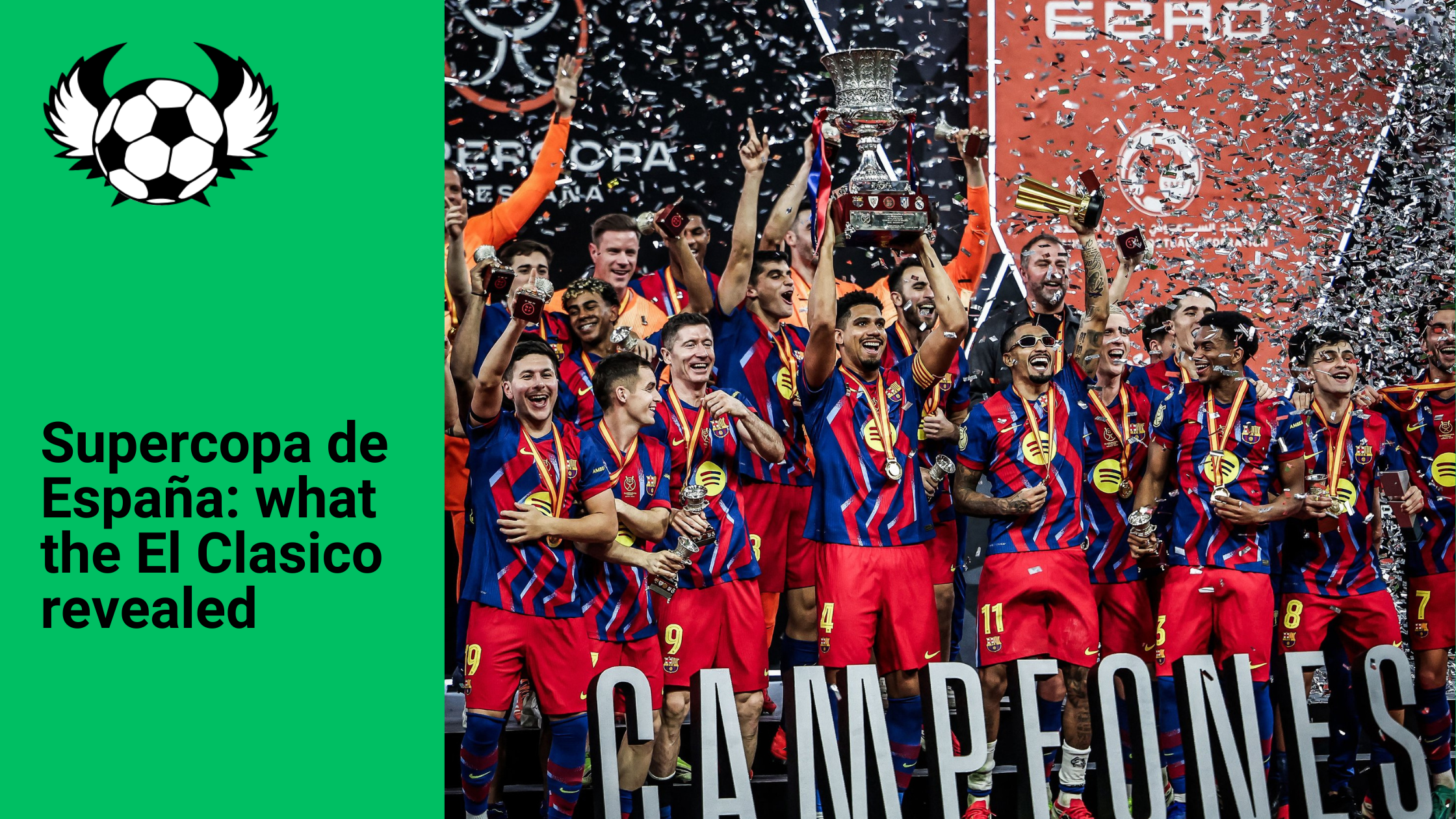
The Spanish Super Cup final delivered another unforgettable El Clasico, but beyond the scoreline, Barcelona’s 3-2 victory over Real Madrid revealed deeper truths about control, mentality, and direction. Played in Saudi Arabia, the Supercopa de España once again served as more than a curtain-raiser. It acted as a statement about where both sides currently stand.
Embed from Getty ImagesBarcelona retained the trophy thanks to a decisive brace from Raphinha and a composed finish from Robert Lewandowski, securing a record-extending 16th Spanish Super Cup title. Real Madrid fought back twice, but ultimately fell short when it mattered most.
Spanish Super Cup Context and Stakes Beyond the Trophy
The Spanish Super Cup has evolved into a psychological battleground. Recent history suggests momentum here often spills into the league season, with the last four winners going on to lift La Liga.
For Barcelona, this final was about reaffirming authority under Hansi Flick. For Real Madrid, led by Xabi Alonso, it was a chance to measure progress in his early tenure. The stakes were amplified by the setting, the rivalry, and the growing narrative around domestic dominance.
This was not just about silverware. It was about direction.
Spanish Super Cup: How the Game Was Won and Lost
The match was decided less by chaos and more by control. Barcelona managed the rhythm of the Spanish Super Cup final better, choosing when to accelerate play and when to slow it down.
Madrid looked dangerous in moments, particularly on the counter through Vinicius Junior, but struggled to sustain pressure. Barcelona, meanwhile, dictated structure. Even when possession swung, their execution during decisive phases separated the two sides.
This was a game won through organisation and lost through inefficiency.
Key Performers Who Shaped the Spanish Super Cup Final
Raphinha was the defining figure of the Supercopa de España final. His two goals showcased both confidence and timing, with the second coming via a deflection that summed up Barcelona’s ability to force decisive moments. He now has seven goals in his last five matches across all competitions.
Embed from Getty ImagesRobert Lewandowski once again proved his value in big games, calmly chipping home Barcelona’s second after intelligent movement and a precise pass from Pedri.
For Real Madrid, Vinicius Junior stood out. His equaliser before halftime was a moment of pure individual brilliance, ending a long scoring drought and reminding everyone of his threat in transition.
Tactical Trends That Defined the Spanish Super Cup
Barcelona’s approach was built on patience and positional discipline. They controlled possession early, forcing Madrid to sit deep and absorb pressure. When spaces opened, they exploited them efficiently rather than relentlessly.
Madrid’s game plan leaned heavily on counter-attacks, particularly down the left. While this produced moments of danger, it left them reactive rather than proactive for long stretches.
The second half slowed considerably, reflecting Barcelona’s comfort in game management once ahead.
What the Spanish Super Cup Result Says About the La Liga Title Race
History suggests the Spanish Super Cup often foreshadows domestic success. Barcelona will hope this victory becomes another platform for a sustained title push.
It also feeds into a broader pattern we have already explored when analyzing how the La Liga title race is increasingly shaped by early-season control rather than late drama.
Real Madrid are not far off, but this result highlighted areas still under construction. Control in big games remains a work in progress under Alonso, especially when chasing rather than dictating.
The gap is not wide, but it is noticeable.
Winners and Losers Beyond the Scoreline
Barcelona’s collective structure emerged stronger than any individual performance. Hansi Flick’s credibility in high-pressure fixtures continues to grow.
For Madrid, questions remain around squad balance and in-game adaptability. The late introduction of Kylian Mbappe, returning from a knee issue, offered little impact and underlined the importance of rhythm over reputation.
Mentality and Game Management Under Pressure
One of Barcelona’s biggest wins came mentally. Even after Frenkie de Jong’s late red card, they defended calmly and almost extended their lead in stoppage time.
Madrid, despite a numerical advantage, lacked composure in the final moments. That difference in mentality proved decisive in the Spanish Super Cup final.
Where Real Madrid Fell Short
Madrid struggled to control the middle phases of the match. While they matched Barcelona for moments of quality, they could not sustain intensity or impose structure once the game slowed.
Defensive transitions also proved costly, particularly for Raphinha’s winner.
Does Spanish Super Cup Momentum Really Matter?
The Spanish Super Cup is not a guarantee of future success, but it often reflects readiness. Barcelona look settled, confident, and tactically coherent. Madrid look competitive, but still evolving.
Momentum alone does not win titles. Direction does.
Final Verdict: Statement Win or Early-Season Illusion?
This Spanish Super Cup triumph felt closer to a statement than an illusion. Barcelona showed control, clarity, and composure against their biggest rivals. Real Madrid showed flashes, but not dominance.
If this final was a glimpse of what is to come, Barcelona have laid down an early marker. The season ahead now has a clear psychological edge.
