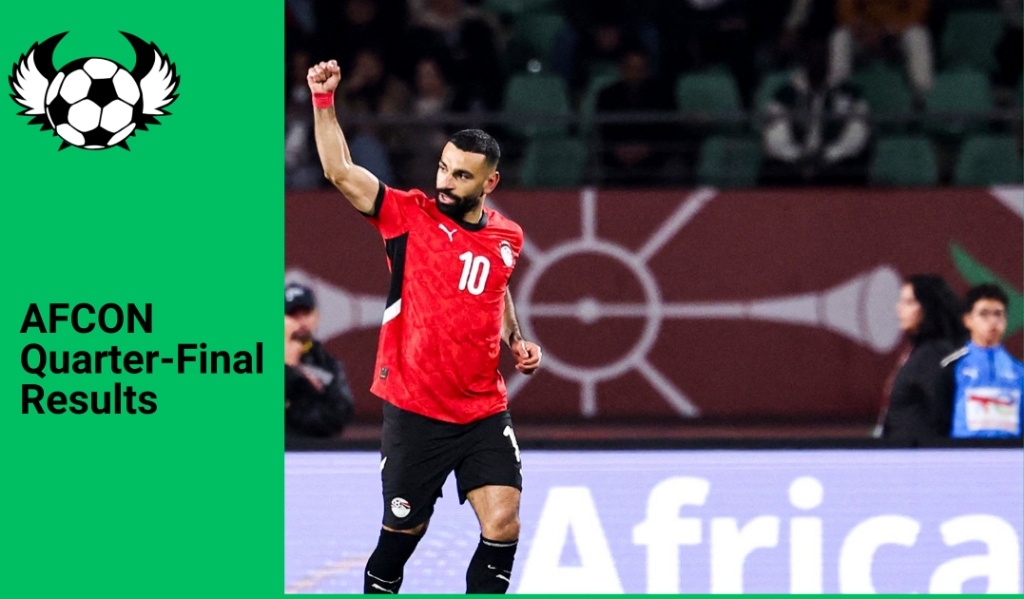
The AFCON quarter-final results delivered drama, tension, and a clearer picture of which teams are truly equipped to win the tournament. As the competition moved into its most demanding phase, the last eight became four, and the margin for error disappeared entirely.
Embed from Getty ImagesBeyond the scorelines, these games revealed patterns. Some teams progressed with authority and composure. Others advanced by surviving moments of chaos. At this stage of AFCON, how you win often matters as much as winning itself.
AFCON Quarter-Final Results and Confirmed Semi-Finalists
The quarter-finals produced four compelling winners and set up a heavyweight final four.
Morocco booked their place in the semi-finals with a controlled 2–0 victory over Cameroon. Goals from Brahim Díaz and Ismaël Saibari reflected Morocco’s growing balance between technical quality and defensive stability. Cameroon struggled to break through a disciplined setup.
Embed from Getty ImagesSenegal edged past Mali with a narrow 1–0 win in a tense, physical encounter. The defending champions were not spectacular but remained solid and patient, traits that continue to define their tournament football.
Embed from Getty ImagesNigeria produced one of the standout performances of the round, beating Algeria 2–0. Victor Osimhen opened the scoring before Akor Adams added a second, as Nigeria’s intensity overwhelmed their opponents.
Embed from Getty ImagesThe most dramatic match saw Egypt defeat Ivory Coast 3–2. Egypt surged ahead early, Ivory Coast responded, but Mohamed Salah’s decisive goal sent the defending champions out and underlined Egypt’s resilience under pressure.
Embed from Getty ImagesSemi-finalists: Morocco, Senegal, Nigeria, Egypt
What the AFCON Quarter-Final Results Reveal About the Title Race
These results narrowed the title race to teams that understand knockout football.
Morocco and Nigeria look the most complete. Morocco control matches without forcing the tempo, while Nigeria combine structure with explosive attacking threats. Senegal continue to thrive defensively, even when games are tight and scrappy.
Egypt’s progression highlighted the value of experience. Their ability to manage pressure, slow the game when needed, and rely on leaders remains a significant advantage in high-stakes matches.
At this point, flair matters less than decision-making.
Key Performers Who Shaped the AFCON Quarter-Final Results
Individual quality once again played a decisive role.
Brahim Díaz has emerged as one of the tournament’s standout performers, offering creativity and composure in crucial moments. Victor Osimhen’s physical presence and movement stretched Algeria and gave Nigeria a focal point they can rely on.
Mohamed Salah’s influence went beyond his goal. His leadership and calmness were evident when Egypt needed control late in the game.
These are the players who tend to decide tournaments, not just matches.
Fine Margins and Tactical Discipline
The quarter-finals were decided by details.
Set-piece defending, transitions, and concentration proved more important than possession dominance. Several teams enjoyed spells of control without creating clear chances, while others maximised limited opportunities.
This round reinforced a familiar AFCON theme. Tournament success often comes down to discipline, patience, and the ability to stay emotionally balanced when the game turns chaotic.
AFCON Quarter-Final Results and the Road to the Final
With Morocco, Senegal, Nigeria, and Egypt remaining, the semi-finals promise clashes of contrasting styles.
Morocco’s structure will be tested by higher-tempo opponents. Nigeria’s attacking power will face organised defensive units. Senegal and Egypt bring experience and tactical maturity that can neutralise momentum quickly.
Squad depth, recovery time, and in-game management will now play decisive roles.
Final Thoughts
The results did more than decide the semi-finalists. They clarified the identity of the tournament.
This is now a competition shaped by control, resilience, and execution under pressure. Teams that manage moments, rather than chase dominance, are the ones still standing.
As AFCON moves closer to its conclusion, the margin between lifting the trophy and going home has never been thinner.
